
MANAGING HARASSMENT IN THE WORKPLACE- DRG
In the workplace today, managing harassment is a critical employer responsibility. It is essential in maintaining employee well-being, fundamental meeting legal compliance requirements, and vital in maintaining employee productivity. Harassment in the workplace is a broad governance priority, carrying both legal risk for the directors, and cost and reputational risk for the company.
Directors and business owners have a fiduciary duty to act decisively in matters where harassment arises in the workplace, and the responsibility to implement proactive measures that safeguard all employees from activities perceived as discrimination. Failure to do so could result in their personal liability, costly litigation for the company, and irreparable damage to the company’s brand and reputation. Employers are under heightened scrutiny to promote safe, respectful working environments through the introduction of the Code of Good Practice on the Prevention and Elimination of Harassment, as defined in South African labour legislation since March 2022.
Eliminating Harassment
Harassment simply cannot be tolerated in the workplace and employers have an obligation to ensure they have taken the necessary steps to act proactively in eliminating harassment. Claims of harassment in the workplace can quickly escalate into legal disputes through the Commission for Conciliation, Mediation and Arbitration (CCMA), labour court actions, and civil lawsuits, resulting in relationship and reputational fallouts and damage claims against the organisation. Harassment is defined in the Employment Equity Act 55 of 1998 (EEA) as unwelcome conduct, inappropriate suggestions, and insinuations. Harassment can be aimed directly at an employee, for example through direct abusive language, acts of violence or indirectly though coercive power.
The EEA’s primary goals are to achieve workplace equity, by eliminating unfair discrimination and implementing affirmative action measures. Unfair discrimination impacts on Constitutional rights of South African citizens, constitutes as a barrier to equality in the workplace, and is prohibited in terms of section 6(1) of the EEA. All employees in South Africa have the right to be treated fairly and with dignity.
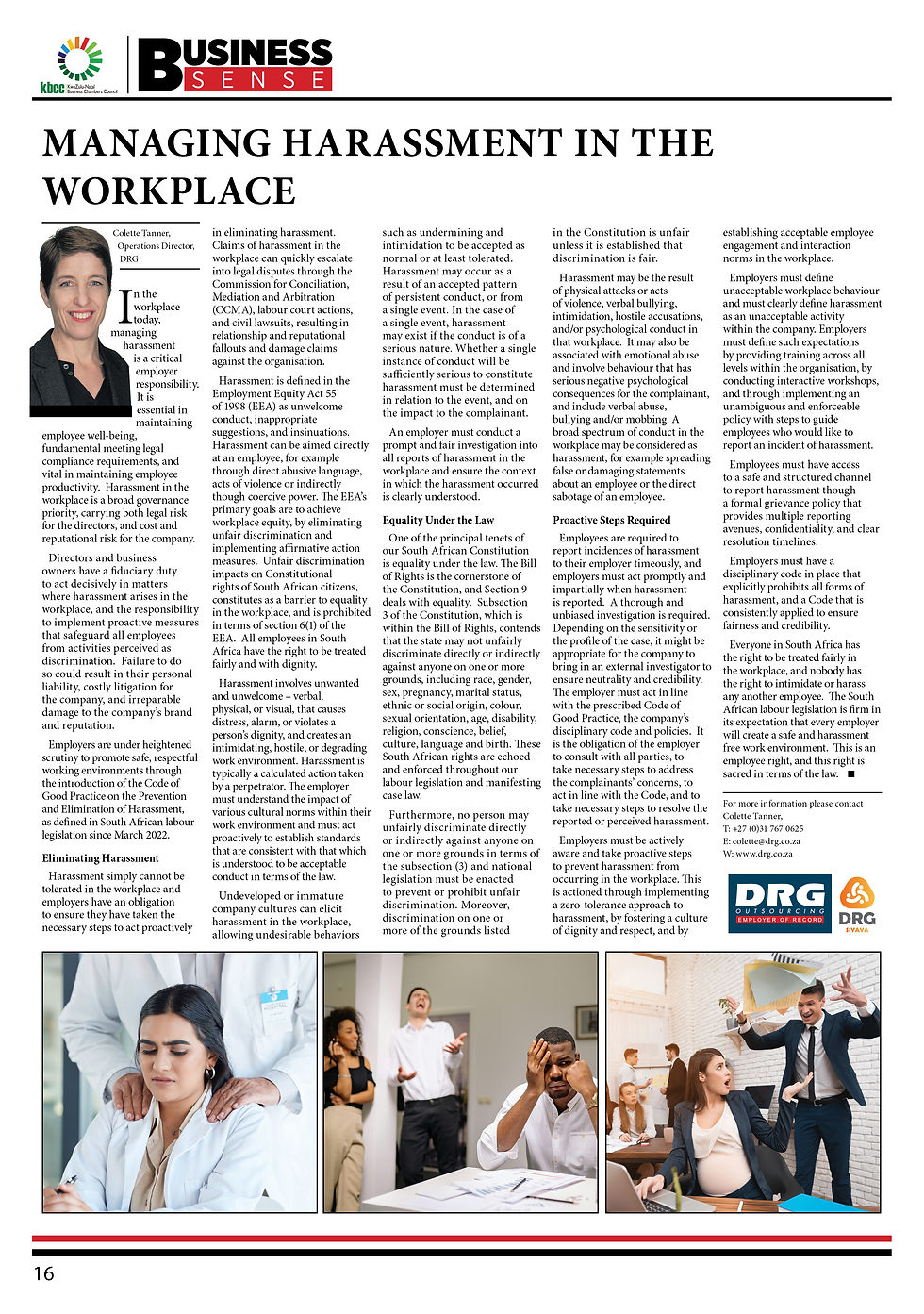
Harassment involves unwanted and unwelcome – verbal, physical, or visual, that causes distress, alarm, or violates a person’s dignity, and creates an intimidating, hostile, or degrading work environment. Harassment is typically a calculated action taken by a perpetrator. The employer must understand the impact of various cultural norms within their work environment and must act proactively to establish standards that are consistent with that which is understood to be acceptable conduct in terms of the law. Undeveloped or immature company cultures can elicit harassment in the workplace, allowing undesirable behaviors such as undermining and intimidation to be accepted as normal or at least tolerated.
Harassment may occur as a result of an accepted pattern of persistent conduct, or from a single event. In the case of a single event, harassment may exist if the conduct is of a serious nature. Whether a single instance of conduct will be sufficiently serious to constitute harassment must be determined in relation to the event, and on the impact to the complainant. An employer must conduct a prompt and fair investigation into all reports of harassment in the workplace and ensure the context in which the harassment occurred is clearly understood.
Equality Under the Law
One of the principal tenets of our South African Constitution is equality under the law. The Bill of Rights is the cornerstone of the Constitution, and Section 9 deals with equality. Subsection 3 of the Constitution, which is within the Bill of Rights, contends that the state may not unfairly discriminate directly or indirectly against anyone on one or more grounds, including race, gender, sex, pregnancy, marital status, ethnic or social origin, colour, sexual orientation, age, disability, religion, conscience, belief, culture, language and birth.
These South African rights are echoed and enforced throughout our labour legislation and manifesting case law. Furthermore, no person may unfairly discriminate directly or indirectly against anyone on one or more grounds in terms of the subsection (3) and national legislation must be enacted to prevent or prohibit unfair discrimination. Moreover, discrimination on one or more of the grounds listed in the Constitution is unfair unless it is established that discrimination is fair.
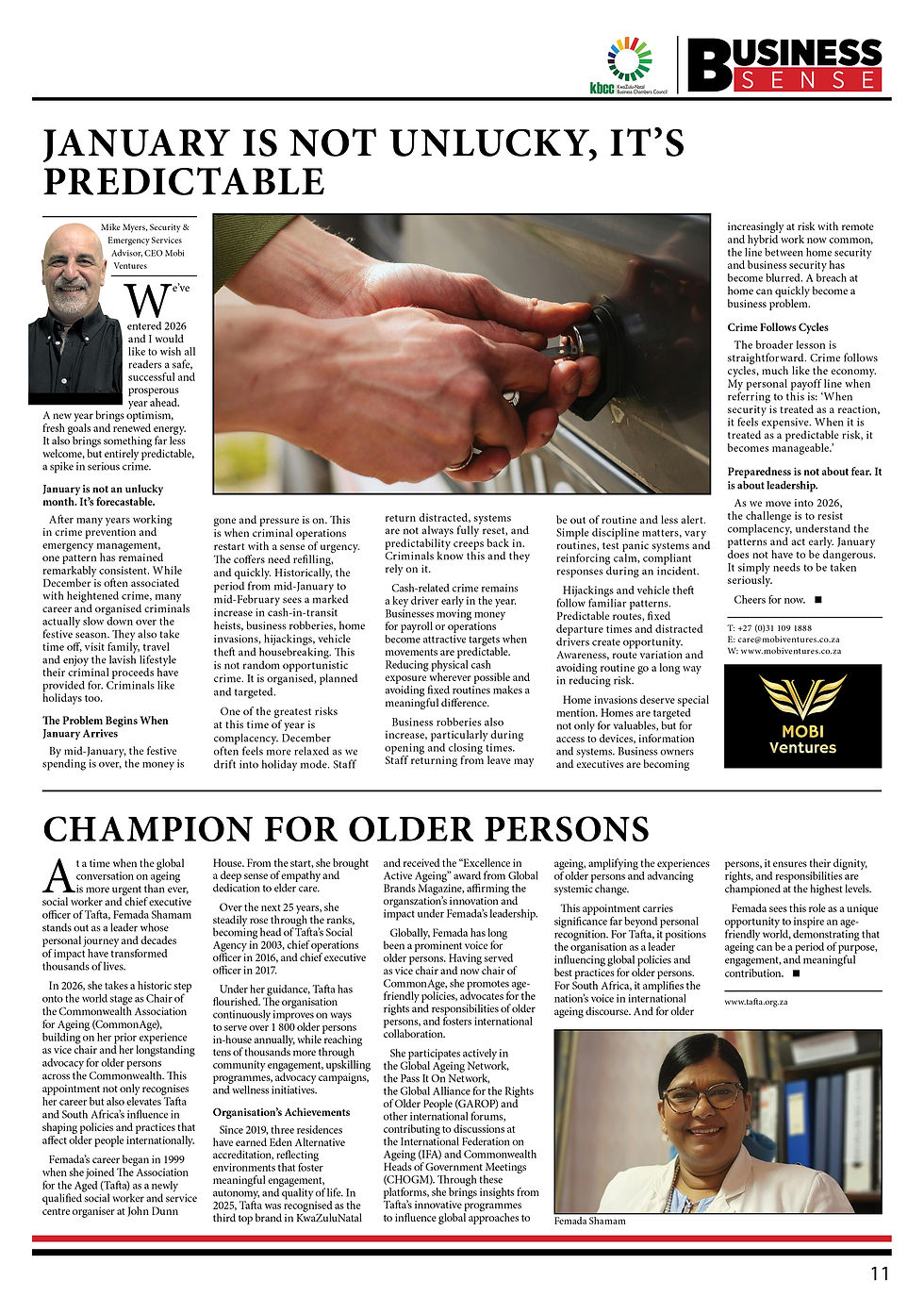
Harassment may be the result of physical attacks or acts of violence, verbal bullying, intimidation, hostile accusations, and/or psychological conduct in that workplace. It may also be associated with emotional abuse and involve behaviour that has serious negative psychological consequences for the complainant, and include verbal abuse, bullying and/or mobbing. A broad spectrum of conduct in the workplace may be considered as harassment, for example spreading false or damaging statements about an employee or the direct sabotage of an employee.
Proactive Steps Required
Employees are required to report incidences of harassment to their employer timeously, and employers must act promptly and impartially when harassment is reported. A thorough and unbiased investigation is required. Depending on the sensitivity or the profile of the case, it might be appropriate for the company to bring in an external investigator to ensure neutrality and credibility.
The employer must act in line with the prescribed Code of Good Practice, the company’s disciplinary code and policies. It is the obligation of the employer to consult with all parties, to take necessary steps to address the complainants’ concerns, to act in line with the Code, and to take necessary steps to resolve the reported or perceived harassment. Employers must be actively aware and take proactive steps to prevent harassment from occurring in the workplace.
This is actioned through implementing a zero-tolerance approach to harassment, by fostering a culture of dignity and respect, and by establishing acceptable employee engagement and interaction norms in the workplace. Employers must define unacceptable workplace behaviour and must clearly define harassment as an unacceptable activity within the company.
Employers must define such expectations by providing training across all levels within the organisation, by conducting interactive workshops, and through implementing an unambiguous and enforceable policy with steps to guide employees who would like to report an incident of harassment.
Employees must have access to a safe and structured channel to report harassment though a formal grievance policy that provides multiple reporting avenues, confidentiality, and clear resolution timelines. Employers must have a disciplinary code in place that explicitly prohibits all forms of harassment, and a Code that is consistently applied to ensure fairness and credibility.
Everyone in South Africa has the right to be treated fairly in the workplace, and nobody has the right to intimidate or harass any another employee. The South African labour legislation is firm in its expectation that every employer will create a safe and harassment free work environment. This is an employee right, and this right is sacred in terms of the law.
For more information please contact Colette Tanner
T: +27 (0)31 767 0625

 |  |  |
 |  |  |
 |  |  |
 |  |  |
 |  |  |


Comments